
Muzaffar Kasimov. How to become a specialist in digitising dreams and reformatting ridiculous fantasies into goals
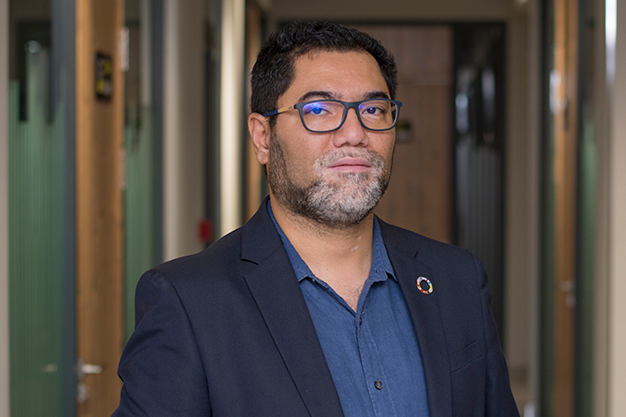
Skills: international economic relations, foreign economic affairs, HR and Finance, consulting, building, setting up and automatising business processes.
Founding partner at HM Partners, co-founder of CLG Leasing, CLG AUTO Leasing, DOIRA TECH, Ground Zero co-working spaces network and TEAM University.
In the past he was a co-founder of Uzbek-Chinese Trading House, Association of International Business and Technology (AMBiT), International Business Travel, TehnoPlaza Industrial Business Centre, TechnoPlaza Servis Markazi and Western Production Technologies.
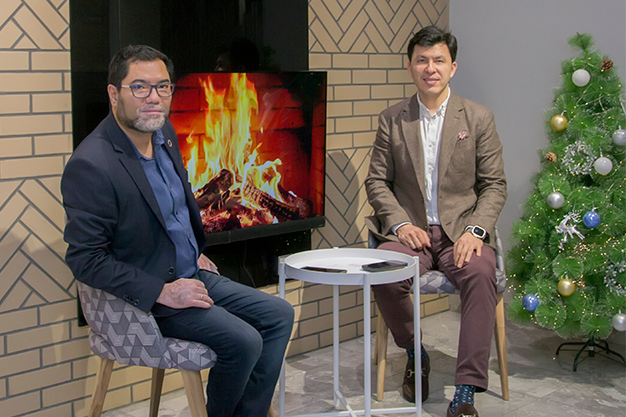
Love lasts three years, friendship lasts fifteen years, and only a karmic bond is forever. The co-operation between Hikmat Abdurakhmanov and Muzaffar Kasymov will be 17 years old in August 2023, from which we conclude that if they do not kill each other in the near future, it is a karmic bond.
Muzaffar: Our partnership started as a friendship, which is even worse. In 90% of cases a business partnership based on friendship does not last even five years. We are completely different, and yet we have the same background: upbringing, education, world view and values. It’s just that the very ideas we are interested in are different. Often what is interesting to Hikmat is not interesting to me, and vice versa. Did he tell you about the DOIRA project? He didn’t? Well, you see, he is less interested in it. But it’s a very cool project, I’ll tell you about it in a moment.
They are the few people who have managed to find harmony in difference and monetise it. Each of them makes up two corners of the Adizes Square. Hikmat a Visionary and Integrator and Muzaffar is a Producer and Administrator. Hikmat is in charge of Dreaming and Moving, while Muzaffar invents buttons so that, like a lazy person, he can automate everything and not have to work. “It’s better to lose a day, then to sprint to the point in five minutes.” This is directly his motto.
Muzaffar: I am also a bureaucrat. Hikmat throws an idea, and I am interested in taking it apart, seeing what‘s inside, understanding what resources are needed, how to calculate it, and criticising it. I like numbers, Hikmat doesn’t like numbers. So I decide whether this beautiful idea is realistic. Of course we argue and quarrel, but we never quarrel as friends. We don’t make personal claims against each other, we fight like business people. We argue, we don’t agree on anything, we go to lunch.
Muzaffar believes that he would be an ideal official, he likes power and difficult tasks. Everything is “blamed” on Hikmat, who persuaded him to go to China. At that time, after the Foreign Ministry, Muzaffar worked at the UNDP on a project to overcome poverty.
“Well,” asked Hikmat, “have you overcome poverty? If not, then I suggest you overcome yours at least.”
Muzaffar: I had a good salary, as much as $560. That was 20 years ago. When Hikmat offered to go to China and said that it was very sad to live on $560 a month for the rest of your life, he knew which buttons to push. I’m not particularly interested in adventure, I’m interested in money. As a tool, as an opportunity to realise everything that is planned.
I love numbers, I love money, I love what it brings: tangible and intangible.
I do have a little bit of a safety cushion though. All money is always in circulation, because business is about managing cash flow, not about wanting to sit on chests of goodies.
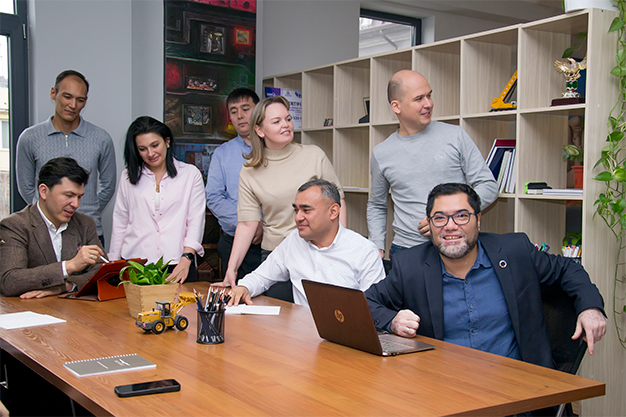
They dealt with poverty quickly, simply because if money is not a goal in itself, it becomes a side effect of any activity that brings pleasure. And if this activity is also automated, you can do nothing, sit with a glass of chianti somewhere in Barcelona and look at the fish market.
Muzaffar: My dream? To sit with a glass of chianti somewhere by the sea, for example in Barcelona, and look at the world. And for someone to recognise me, come up to me, say hello, ask me how I’m doing. And I’d be like, “It’s fine, we’re working. And then he would introduce me to his companions and say that this is the same Muzafar Kasymov who created the revolutionary system… (I don’t know what it will be). Do you know where he’s from? He’s from Uzbekistan. Ah, is this the technological country that has made a qualitative leap, which the world calls the Uzbek Miracle?
It’s not the money that I want to show off. It’s not about what I can afford. I want to be proud of the products we’ve made. The ideas we’ve implemented. The innovations we pioneered. And, of course, of a country that has earned the right to be considered first in some areas.
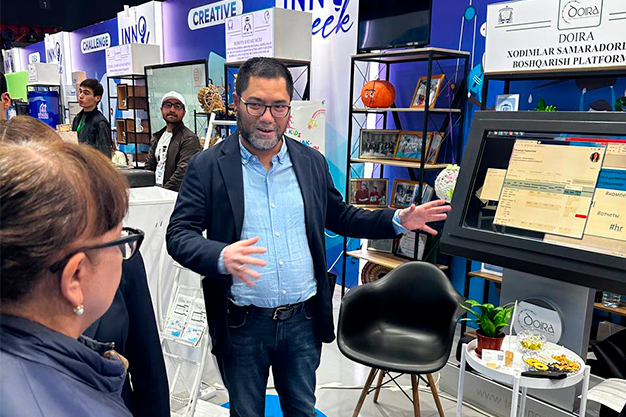
So about DOIRA. Muzafar explained to me three times what it was, first as for an adult, then as for an eleven-year-old, then he repeated it again to consolidate the material.
DOIRA is a domestic intellectual product that can evaluate the efficiency of any employee, give measurable indicators of the feeling “that nobody works, only I plough like an ox”. It is essential for HR-specialists who need performance and potential metrics for each employee to respond to all staff problems in time.
Muzaffar: So a job seeker comes to the company, gives his CV, HR puts all his data and competences into a table and creates a dossier. Then they set goals for his position. For a probationary period, six months or a year. When the probation ends, HR conditionally “ticks off” the set goals, and a clear, measurable picture of the person’s contribution to the company appears. At the same time, it looks at how fully the potential has been realised. And this immediately tells us whether the applicant is suitable for the organisation or not.
The result is recorded by the manager every month, and in the end you can digitise the efficiency and effectiveness of each person for a certain period of time. That is, it is the most objective result possible.
It is ready, this product. It is affordable, unlike its foreign analogues, and is now moving to cloud servers. Such a programme may be in demand not only by business, but also by the state, if, of course, the goal is to effectively set up the work of a ministry or department, and not just to sit around in offices. The programme provides not only KPIs and a competency map for each employee, but also recommendations on what to do with them. Of course, this programme should be handled by professional HR, people who know what internal PR is and how to create a team that can turn mountains.
Muzaffar: We made it on the server, for ourselves, but then we decided to monetise it and share it. We have a methodology inside, how to calculate these formulas, how to interpret them. We need to finalise it so that it can be a product. We need to make a nice, friendly interface, a cloud solution, so that this programme is completely autonomous and does not depend on us. Sign up and work.
Why DOIRA? Because it is similar to our national instrument – tune it just right and you will hear unique music.
The businessmen plan to show the product to entrepreneurs in March-April. And the most important task here will be to explain how important it is to have a well-coordinated team that works like clockwork.
Because in most organisations, people are hired on all sorts of principles, just not on the basis of scientific analysis.
Well, we’ll see.
Given their ability to promote their ideas and consolidate the business community, they should do well in a painless and interesting way.
And in general, having made a sharp turn towards the service economy, both Muzaffar and Hikmat were more than excited to pick up the strata of this sphere.
Which of them has it easier in this economy? The extroverted Hikmat or the inner introvert Muzaffar?
Muzafar: You generally misunderstand who extroverts and introverts are. Let me explain. It doesn’t mean that an extrovert will necessarily wither without communication, and an introvert doesn’t like people. It means that people get their energy in different ways. Some people get their energy from people, from their ideas, movement, noise and conversations. From socialising. I am also cheerful, I like to laugh in company, relax and dance. But I do not accumulate energy from it, I spend it among people. And I accumulate energy when I sit alone in my office and think about an idea. I draw an Excel spreadsheet. Click on a calculator. Take apart screws and look at what’s inside. This is the source of my energy.
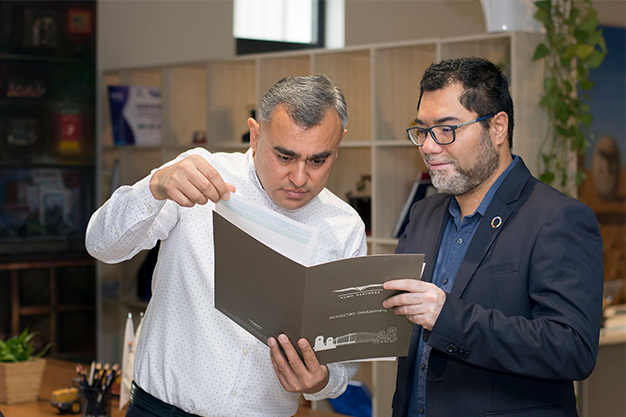
Muzaffar has a specific plan of where he should be at a certain point in time and at what age. The plan may change, but I think he is very interested in how he moves along these invisible lines. And that’s what brings him pleasure.
Muzaffar: Have I mentioned that I am a lazy person? If it’s a choice between working or sleeping, I’ll sleep. But laziness is the engine of progress, because you first have to think of something that works for you and doesn’t require daily effort.
I believe that a lazy person can be very effective.
Why did we end up creating this programme? Because we were too lazy to deal with each employee individually.
Apart from laziness and unwillingness to work, he has one more quality in common with Hikmat – honesty. Muzaffar does not like to say that he is honest: it is not in his character, it sounds too pathos and high-minded for him. He says honesty is profitable. It can be calculated and monetised.
They could have played dirty, Muzaffar is posh with numbers and would have made sure that with any sly play they would be financially where they are now. And possibly even much higher. But…
A lot of companies in the 2000s were playing multiples cards, screwing over partners and cheating customers. There was plenty of money, and even more opportunities: you just needed time to collect them. Now those who have survived make up clean, beautiful stories of formation. But history is not so easy to launder. There will always be people who know the truth.
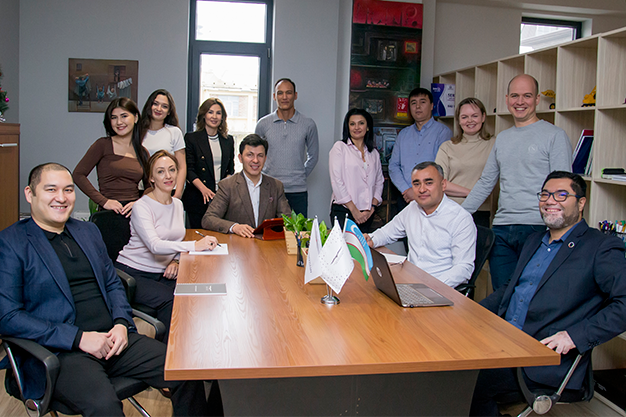
HM Partners chose reputation from the start and have not regretted it. This is a group of companies that are pleasant and safe to do business with, people who have no fog in their backgrounds. A beautiful, fun, adventurous story full of ups, downs and communication at all levels.
There is one more person at HM Partners, an interview with whom will make our story about the company more complete and versatile, and that is Gavkhar Safayeva. A mediator, a boundary post between lyrics and maths, a glass of cool water in any dispute.
And her story is no less interesting, because she is an HR director and knows exactly what HM Partners has that employees appreciate so much. She will also tell you how the company has grown in terms of working with personnel and all the stages of restructuring that the founders talked about.
Sasha Ivanujenko