
Hikmat Abdurakhmanov. How to become a leading expert in a monetisation of reputation and dream management
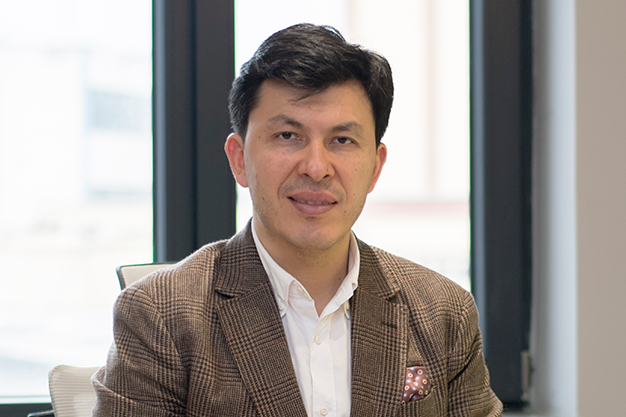
skills: founding partner at HM Partners, co-founder of CLG Leasing, CLG AUTO Leasing, Ground Zero co-working space’s network, co-founder of TEAM University.
In the past, he was the head of the Uzbek-Chinese Trading House representative office, chairman of the Association of International Business and Technology (AMBiT), co-founder of International Business Travel, TehnoPlaza Industrial Business Center, TechnoPlaza Servis Markazi and Western Production Technologies.
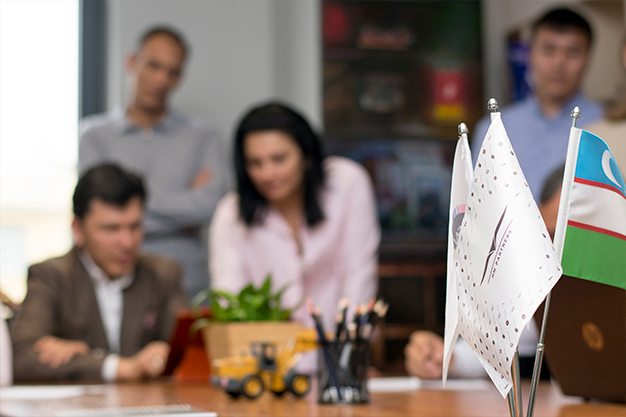
In August 2023, the HM Partners team celebrated its 17th anniversary. According to Hikmat Abdurakhmanov, these are seventeen years of exciting adventures. We will talk separately about how the other business partners feel about it, but it is Hikmat who regards this experience as one big exciting journey after a dream. Which, of course, is still going on, and the most interesting things seem to be ahead. Because over 17 years, the dream has changed several times, plans have been ruined and rebuilt, and this amazing unpredictability, however paradoxical it may sound, has turned out to be a good foundation for moving forward.
For Hikmat, it started with the thought, “Where am I going, who am I, and how interested am I in being a cog in a large and stable government machine?”
Hikmat graduated from the University of World Economy and Diplomacy and worked in a government agency for a year and a half: “selling cotton”, learning the science of contract drafting, terminology and negotiations. Then he studied in Scotland and graduated from the 4th Professional Management Program (PMP-4) at the UJC. Because the university gave an idea of international economic relations as a science, which could not be applied in practice anywhere. And Hikmat wanted to earn a little more than the transportation cost to the government office.
Hikmat: More than half of my classmates in my business school in St. Andrews were from China. And for me it was a shock, imagine, a small town in Scotland, an ancient university with traditions, where you expect anyone but not Chinese, and there were more than half of them. And when we talked to them, every other one said they were either the son or nephew of some manufacturing people. Some had a box factory there, others had a textile factory, and so on. From which I realized that in China, realistically, there is a lot of money now and people there are starting to learn business. The country is moving forward by leaps and bounds.
When Hikmat returned from Scotland, he began to gather his friends to travel beyond the Tien Shan – to the Big Dragon. He made a good leader because he managed to persuade everyone.
Muzaffar Kasymov was working on a poverty alleviation project at UNDP at the time. A second friend, Ulugbek Kholmatov, worked in a bank, and he too was open to adventures.
They went to China quite spontaneously: two friends and Hikmat and his family. At that time, the daughter was two years old, and the businessman himself was 25. He had a few dollars in his pocket and an idea of the Chinese trading machine as something grandiose and huge, which should be urgently brought closer to Uzbekistan.
They started with the city of Guanzhou, which few people could find on a map at that time. And they began to bring it closer to Tashkent, presenting Chinese equipment and raw materials to domestic businessmen as best as they could.
Hikmat: And when I told them: “Let’s go to Guangzhou, there are a couple of people we know there, and we’ll hook up something there?”, they didn’t hesitate for a long time. They each bought a ticket. And I also took my wife and daughter with me, and we left. That’s how our adventures in China began. It was the summer of 2006. For six months we had no orders. We were finalizing, to put it in modern terms, the business model.
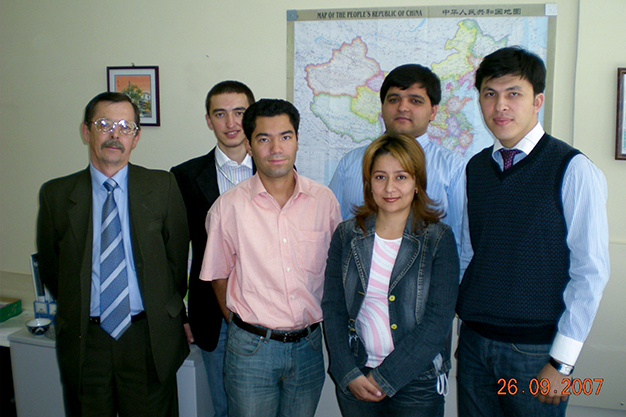
Well, that is, they were sitting without income, living on their savings. Aziza Umarova (wife) – well done. This wise woman can easily earn and feed her family and pull projects of any complexity herself. But to Hikmat she said: “Money for the family is your headache.” For the young father, it was a huge incentive to earn and the best thing a wife can do for an ambitious man.
Friends lasted for six months. At the same time, they did translations, loaded containers, and took any kind of part-time work. And then, in February 2007, they got their first contract. Happiness it was.
This contract was entrusted to them by a good man from «Media Farm» company, Khairulla Bakhodirov. He placed an order for medical equipment for 24 000 dollars, with a 10% commission. And the first thing he asked them was: “Guys, you won’t screw me, will you?»
At that time, “screwing partners over” and breaking commitments was a «must have» for budding entrepreneurs. No one doubted one another in these terms and had no illusions.
Later, Khairulla-aka will say one funny thing: “Thank you for not screwing me. I’ve noticed that you are a little too intelligent for this business, it’s strange…”.
The first income from the dream business model amounted to $2,400, which friends divided and also distributed the salaries of two employees who worked in a small office in Tashkent and took applications from entrepreneurs.
Then the company was involved in business tourism, sending delegations of entrepreneurs to Canton and other fairs, meeting them at Chinese exhibitions, negotiating on their behalf, concluding contracts. They looked for the necessary equipment and machinery all over the Middle Kingdom, and it would have been very difficult without Google.
In 2009, guys already represented several factories, opened a leasing company, and began construction of the TechnoPlaza business center.
Back then it was swimming against the current. They were told, “Aren’t you afraid to do this kind of thing?». There is no cash in an envelope, there is no normal business landscape, everything is based on a very fast buy-sell cycle, and they were trusted with deferred payments for up to six months, which was how long they had to wait for conversion.
Hikmat: Those who used to be involved in foreign trade, imports, exports, know that finding hard currency was a headache. Everyone solved it in his own way. Some people found exporters and exchanged currency with them, others went to the stock exchange and exchanged money at a very high rate, and some took installments from factories, if they trusted them, and paid back in six months, a year…. For us, the issue of conversion was not so acute: we did not deal with consumer goods and were only concerned with production technologies, i.e. equipment, and these items were considered more or less a priority for the economy, and conversion was done, but with a delay of six months to a year.
And in 2010, we felt that we needed to unite businessmen. It is not enough just to sell them something, some services. We saw a very strong marketing tool for our strategy – to help businessmen by uniting them and by strengthening the business community. We concluded an agreement with the Chamber of Commerce and Industry and represented their services in China. We got a unique status when the Chamber of Commerce and Industry perceived us as their representatives in China. Therefore, if our entrepreneurs had problems in China and needed to perform representative functions, we took it upon ourselves and thus solved business problems for the business community in Uzbekistan.
That’s what we liked about it. It helped to build the right reputation and image and was a great addition to the existing business. We did “business advocacy”, which is a term that means representing the interests of business in society, government agencies, and before foreign partners. To do this, we registered an independent business association, the Association of International Business and Technology.
Then the businessmen represented the interests of The International Buyer Program (IBP), which was a program of the U.S. Department of Commerce, and sent businessmen to American specialized exhibitions. This gave them the opportunity to register for free at the exhibition itself and to obtain a visa. They were among the first to send a delegation to Silicon Valley, 15 people together with the organizers, to California – San Diego, Los Angeles, San Francisco… They toured the coolest places, where they learned such words as acceleration, co-working, incubators, startups, ecosystem…. “Caught up”, and in 2017 they opened GroundZero – their first co-working space.
Unfortunately, that very first famous first branch, where awesome and fun hangouts and meetings were held, has closed. But the whole floor has blended in very well with the new TEAM University. It now has a beautiful library.
Hikmat: The cool atmosphere has remained there, and it has become an integral part of our university. Therefore, the first branch of the co-working center is alive, just in a slightly different role.
The year 2017 came, the liberalization of the economy and the opening of conversion began. And the partners realized that they were losing the main “advantage” of their business – an exclusive window to China. It was necessary to renew themselves.
Hikmat: For this purpose, we decided to undergo training at the Skolkovo Business School. It was an opportunity for us to rethink what we were doing, to rebuild our business. We, three partners, invested a lot of money in this. I remember back then, the training alone cost each of us $20,000, plus flights, accommodation, etc. But it was a cool investment, because we saw what was happening in neighboring countries, met amazing entrepreneurs from Russia, Kazakhstan, and other countries.
At that time, our business was a strong trading business and international intermediary service. Sales of special equipment amounted to hundreds of machines a year. We had our own service center, a large spare parts warehouse, i.e. a trade post-service, which should accompany any complex sales. At the same time, we saw a shift towards a service economy.
Since 2017, every year, we organize Entrepreneurship Week. This year it was held for the seventh time. It helped us to integrate globally and see what is happening around the world in the field of entrepreneurship. We attended forums, got acquainted, invited specialists to join us, and began to fulfill the function of a platform for entrepreneurs. And thanks to our leasing business and co-working activities, we began to realize that service business is more interesting and we have a future in it.
Hikmat and partners lost no small amount of money during the pandemic, as indeed did the rest of the business. At the peak, they were stuck with about $5,000,000 worth of inventory. Friends were going through a huge crisis period, this involved both downsizing and a complete overhaul of the business model. The company was going into debt and a massive restructuring was underway.
The five co-working spaces were unprofitable, and existed as a favorite toy they could afford. But after the pandemic, they made a promise to themselves: “No unprofitable projects”.
Hikmat: We were unfortunately forced to close the Association. We closed five co-working branches out of six, in fact, we closed the business completely, and then we rebuilt it. And since then we have had three co-working branches, but each one is two or three times bigger than the previous ones. If one branch used to be 200-300 square meters, now the average is about 1,000.
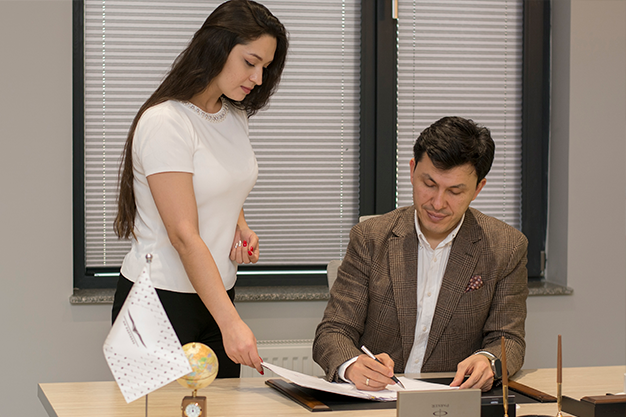
So, back to the question of evolution. While at Skolkovo, the guys got excited about the idea of their own university. Just at that time, the country’s leadership sent a signal to the businessmen that it was ready to consider private initiatives in education. The idea had been floating around in the offices of HM Partners for exactly two years, during which time the businessmen had studied how educational institutions around the world worked and what kind of business model they used.
Before opening TEAM University, $150,000 was spent on research: they hired a British consulting company to find an academic partner, toured dozens of universities near and far.
In April 2020, right in the middle of the lockdown, the Cabinet of Ministers issued a decree on the establishment of TEAM University. After two years of traveling around the countries and offices of our officials, they have finally achieved the opportunity to open a private university. There was a revolution in the education system.
Hikmat: Our task during this period was to gather a staff of professors, teachers, to build a team that would deal with the first enrollment of students, to renovate and redesign our building – five levels, 4,000 square meters. Because now it was a function of a university, not an industrial business center.
The first year, the university accepted just under a hundred students. Now, with the fourth intake – 350 students, four faculties: three with a London partner and one with the American Hoteliers Association.
Hikmat: So the university has added a knowledge-based economy to our business, quite dramatically redirected activity toward service.
In 2022, when we had dealt with all the problems, we finally decided to get out of the trading business.
Of the four partners, only two, Hikmat and Muzafar, remain – their initials have been incorporated into the name of the existing HM Partners group of companies.
Hikmat and Muzzaffar are often asked how they managed to work together for seventeen years and remain partners. That’s a good question.
It seems to me, because they are «a little too intelligent for business” and came to this galley not to make money, but just to live life: bright and exciting, and through heated arguments and discussions they share ideas only, not profits.
But we’ll still ask Muzafar. He has a scheme and he is ready to share it. Because Muzafar is a leading expert in “digitizing dreams” and reformatting fantasies into goals.
That’s what we’ll do in the next publication.
Sasha Ivanujenko